Die casting is the process of pouring molten metal into a mold to obtain the desired shape. This process is generally used for high production volumes and is capable of producing complex shapes. In order to achieve the desired final dimensions and shape, the die casting mold must be precisely machined.
This is where our Pentapod CNC machines come in. In this blog post, we look at the benefits of machining a die casting mold with our Pentapods and explain why you should consider this method for your die casting applications.
Basics of die casting and CNC production of casting molds
As mentioned above, the die casting process involves pouring molten metal into a mold to produce the desired part. Die casting is a traditional manufacturing process that offers many advantages, such as high production rates, consistent quality and the ability to produce complex shapes.
Before looking at CNC machining, it is important to know how die casting works. There are different methods of die casting, such as gravity die casting, low pressure die casting and high pressure die casting. The main difference between these methods is the pressure with which the molten metal is poured into the mold.
These are generally the 4 steps of a typical casting process:
- Preparation: The mold must be prepared before starting the gravity die casting process. The idea is to heat it to a certain temperature and apply a refractory coating or lubricant to it.
- Injection: Once the preparation phase is complete, the next step is to take molten metal directly from the furnace and pour it into a mold via a downward-facing spout. This can be done either by hand or with an automatic machine, but in both cases gravity draws the molten liquid down into the mold.
- Cooling: The metal should cool and solidify after it has been poured into the mold. The metal must have sufficient time to take the shape of the mold and it must be completely hardened before the mold is removed.
- Eject and deburr: When sufficient time has elapsed, the mold halves are released and opened, and the castings are carefully removed. Finally, the excess material is cut off. The part is usually cleaned before delivery to the customer.
The requirements for the die casting tool are therefore a high form and position tolerance, a high form complexity and a high material load.
Therefore, such die casting molds must be made of highly wear-resistant materials. The requirements for a CNC machine are as follows:
- High rigidity of the machine
- High dynamics and accuracy
- Flexibility (for different die casting molds)
- High degree of automation
- Thermal stability (adverse ambient conditions)
Therefore, high demands are placed on a CNC machine for the production of die casting molds.
The benefits of machining die casting mold with our Pentapods
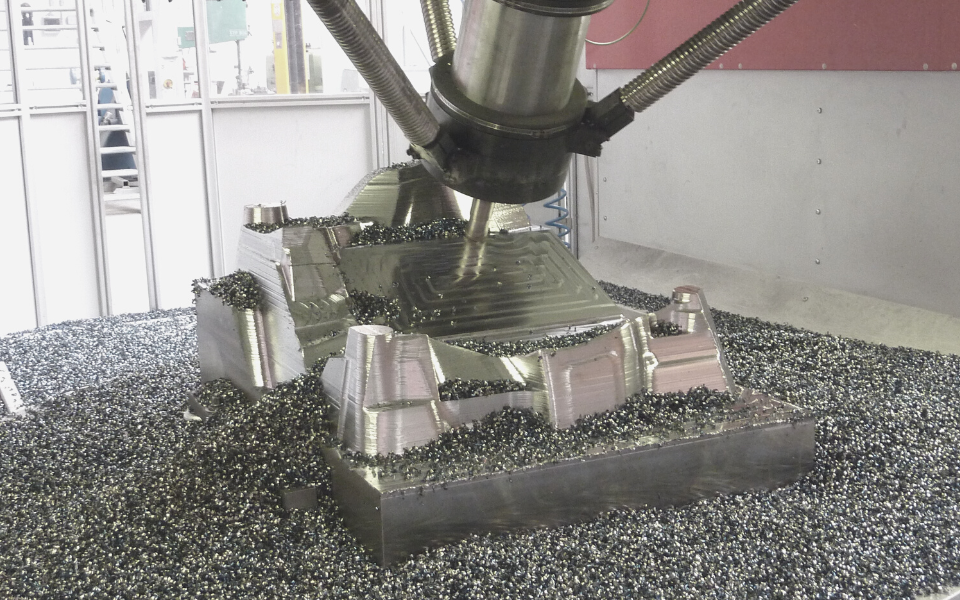
We have been building these patented and unique CNC machines for 20 years. It is immediately apparent that these CNC machines differ from those of conventional manufacturers. This is due to the external icosahedron design and the five ball screws protruding from the machine. But it is precisely these differences that provide the decisive advantages when machining large and difficult-to-machine molds.
These are the decisive advantages in the production of casting molds with our CNC machines:
- High production rates: High production rates can be achieved with our Pentapods. This is due to the fact that our machines achieve a high metal removal rate with a high working feed rate (60,000 mm/min) during machining.
- Consistent quality: With our pentapods, you can achieve repeatable component quality. This is because our machines have a high level of repeat accuracy, even with large workpieces.
- Ability to produce complex molds: With our Pentapods, you can produce your casting mold with complex shapes. This is because our machines with the 5-strut parallel kinematics can machine a part from 5 sides in one clamping. The spindle can even be tilted by up to 90° in one direction, which ensures a high degree of flexibility.
- Robust yet precise: Our CNC machines are extremely robust and precise, even under adverse environmental conditions. The accuracy is achieved in particular by the high inherent rigidity of the machine thanks to the icosahedron shape. Even with fluctuating ambient temperatures, the machine works with consistent accuracy thanks to the integrated temperature control of the housing and the struts. Finally, the ball screws are protected from environmental contamination by a pressurized hood.
Conclusion
In summary, machining a mold with our Pentapods offers many advantages, including high production rates, consistent quality, the ability to produce complex molds and resistance to environmental conditions. Our machines are the perfect solution for mold production. Contact us today to learn more about our machines and how we can help you achieve your mold making goals.
However, if you are looking for a contract manufacturer for mold making, we can recommend millfax GmbH. We have been working with this company for 20 years, which carries out production with our Pentapod machining centers.